
On Thursday, June 12th we discussed the regional disaster risks we are facing here in Xàbia- both natural and man-made – and how we might prepare for such eventualities.
Our local situation:
“Property agents are fond of saying that the WHO recognises Jávea as having “one of the best climates in the world”. What they fail to reveal is that Jávea also holds the Spanish record for the most rainfall in a single day, 871mm, almost three feet of rain over a 24 hour period on October 2nd 1957. This is one of the highest daily rainfall figures for the whole of Europe, and not far off figures quoted for tropical storms and monsoons. Indeed, the Comunidad Valenciana is renowned for its range of extraordinary natural events such as earthquakes, landslides, torrential rain, hailstones, high winds, temporary lack of rain, abnormally high and low temperaures, not to mention bush fires and violent thunderstorms. As a result, according to Professor J. Olcina Cantos of Alicante University, the Comunidad Valenciana is one of the most risky regions in Spain. Welcome to “Paradise” ! http://agenda21-xabia.wikidot.com/javea-s-inescapable-floods
Flooding:
This paper, from 2010, by Prof Olcina studied the increased risk of flooding in three locations on the Alicante coast resulting from urban occupation of areas subject to this hazard.: https://nhess.copernicus.org/articles/10/2229/2010/nhess-10-2229-2010.pdf The lessons it describes still need to be learned !
We watched a couple of videos of the Javea Computer Club flooding 17 years ago when the river broke its banks.
After that eventful episode, we were able to rescue a lot of equipment, clean up the place and carry on, but the premises suffered another, devastating flood in 2019 and lost its license for use as a club-house.
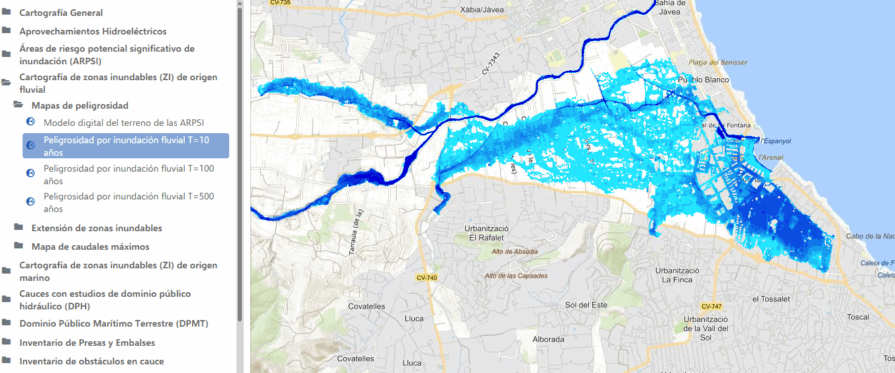
It’s informative to look at maps of flood-prone areas in Spain which are available on this site: https://sig.mapama.gob.es/snczi/index.html?herramienta=DPHZI. Here are some screen-shots of maps for Xàbia: First, the danger of flooding from the river in a one in 10 year event. As we can see, the Arenal is particularly at risk.
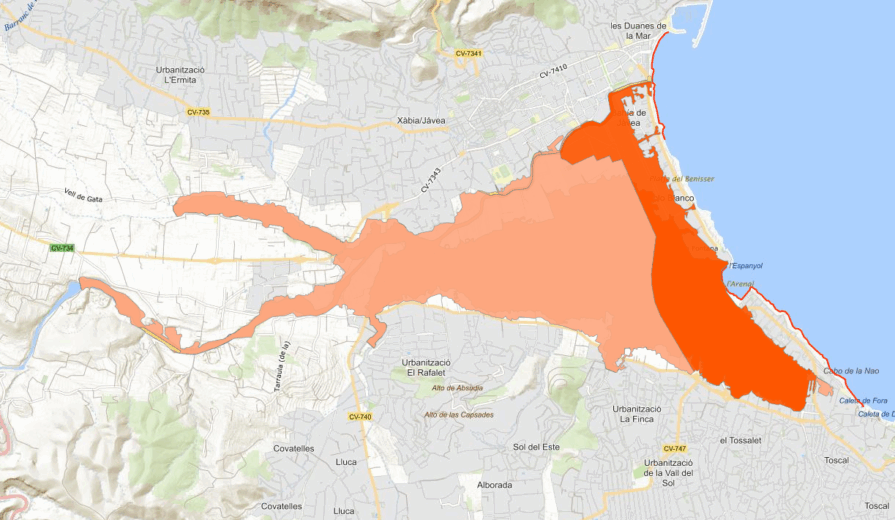
The second image is the risk of flooding from the river in a one in 500-year event. The flood zone covers all the low lying land south of the Gorgos river. With climate change, such events are likely to become more frequent. Margaret described how a combination of bad drainage, urban development and heavy rain caused flooding in the Pinosol urbanisation.
Wildfires:
Another risk we are particularly exposed to is wildfire. Here is a quote from “The Ecology of Wildfires in the Mediterranean” in “The Nature of Mediterranean Europe – An Ecological History” by A.T. Grove and Oliver Rackham (2003)”
“Fire is a natural part of many Mediterranean ecosystems, but people leave it out of their calculations and plans. It comes as a surprise which repetition does little to diminish. It threatens human life when people insist on building houses among fiery vegetation. Foresters grow flammable trees and expect them to reach timber size in the intervals between fires. Experience in California shows that fire cannot be eliminated by any action short of eliminating combustible vegetation. Attempts to suppress fires merely accumulate fuel to cause super-conflagrations later. Although the plants are different, the Mediterranean behaves similarly. in the twentieth century, when there was a struggle between shepherds and foresters that the foresters eventually won, shows that to suppress browsing can result in a fire-dominated landscape.
We are unsure how the present frequencies of fires and conflagrations are related to those of a century ago or of aboriginal times. Fires seldom happen for the first time in long-established vegetation that has never burnt before..”
There are more quotes from this book on: http://agenda21-xabia.wikidot.com/wild-fires . The authors specifically criticise the planting of pines and eucalyptus.
Chris’s house had a brush with a wildfire in 1993. The pine forest which had been on two sides of the property went up in flames in a fire spread by high winds from the rubbish-burning site on Tossal Gros. The house was undamaged. It is of traditional design with thick walls and the windows are protected by iron rejas and wooden shutters which shut from the inside. There’s also a 4-5m gravel drive between the house and the forest. Margaret remarked that, in a more recent fire, a house on Pinosol located very close to an empty plot had been gutted when the heat of the fire broke the window glass.
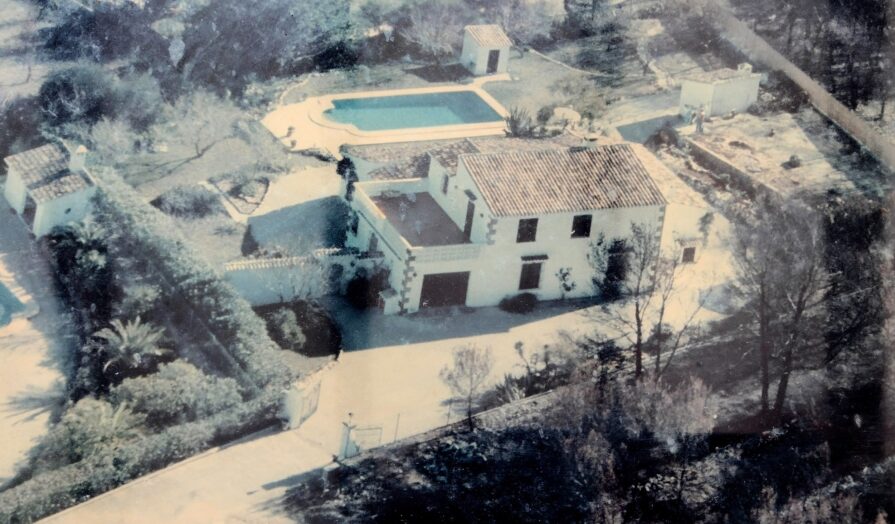
Margaret suggested a couple of useful tips. If you live in a fire risk zone and have flammable naya furniture, take it off the naya if you are going to be away (or if there’s a fire alert). If fire is approaching, put gas bottles in the swimming pool (if you have one!). Chris remarked that one of the take-aways from the recent Californian fires was that houses left unscathed were those designed to resist fire.
We discussed the fire risk posed by the large number of dead pines in local forests caused by last year’s drought. Perhaps they should be cut and converted into chips? But think of the difficulty reaching them and the cost. Are they more of a fire risk than living pines (which love fires to propagate!). Most forest fires are caused by human activity – usually negligence, though more recently arson, although the big Vall d’Ebo fire (August 2022) was caused by lightning. (Afterthought: Perhaps we should just let the fires burn themselves out naturally and concentrate on protecting property and crops. Since fire is a part of the Mediterranean ecosystem the forest will regenerate itself.
Be forewarned !
The Spanish Met office has a site dedicated to meterological notifications: https://www.aemet.es/es/lineas_de_interes/meteoalerta
This includes current warnings (in English) https://www.aemet.es/en/eltiempo/prediccion/avisos
It also provides a link to the EUMetNet Europe-wide warnings: https://meteoalarm.org/en/live/
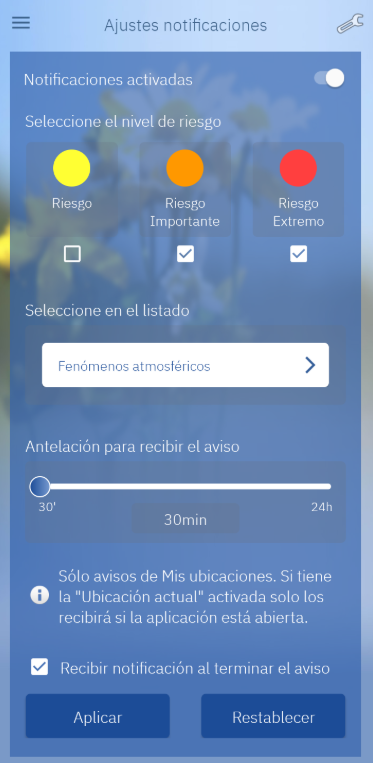
The AEMet weather app has an option to send warnings directly to your smartphone. https://www.aemet.es/en/app/eltiempodeAEMET Here’s a translation of the blurb:
“If you want to know where it will rain, if the winds are going to be strong or if adverse weather phenomena are expected in your municipality, the latest predictions and official warnings from the State Meteorological Agency (AEMET) are within reach of your mobile with this simple application.
Accurate, detailed and permanently updated information in a clear and friendly format.
The application, if you have geolocation activated, automatically identifies the place where the device from which it is consulted is located and shows the expected time for that municipality. In addition, it is also possible to obtain the prediction in any other municipality in Spain through a simple and fast search engine.
You will be promptly informed of adverse weather events in your preferred municipalities if you keep notifications activated.
In response to the suggestions of our users and to facilitate the use of meteorological information, AEMET has begun the implementation of a new notification service for warnings of adverse meteorological phenomena corresponding to your favorite municipalities. In addition, they can be filtered by atmospheric phenomenon and risk level, being able to establish the advance notice to receive them.
The app lists 13 atmospheric phenomena including high and low temperatures, rain, dust, storms, snow and “galernas” (??? I had to look this up: … a sudden and violent storm with strong gusts of wind from the west to the northwest that usually hits some areas of the Cantabrian Sea and the Bay of Biscay, usually between spring and autumn. So now you know..)
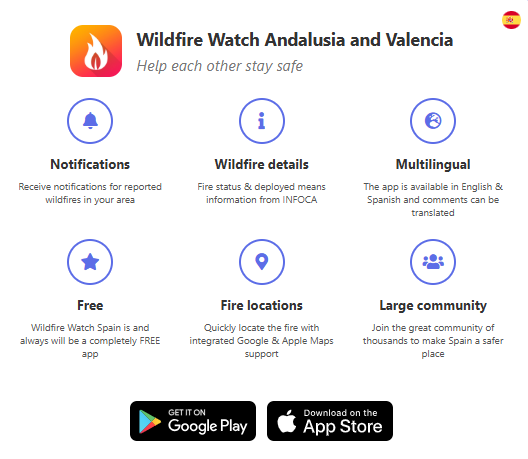
A very useful app for wildfires is Wildfire Watch: https://www.wildfirewatch.app/en
It might be worth following the Local Police, Town Hall and Civic Protection on Facebook, Instagram or X to receive the latest news. If you happen to see or experience something amiss, there are two phone apps to send alerts to the Xabia Town Hall and emergency services: Xàbialerta and Xàbiaconecta . The latter works well for reporting incidences such as water leaks and loose manhole covers. Xabialerta is a new app – and Chris discovered that she could not cancel an alert she had sent by mistake!

If you are in a risk Zone – Be prepared
This article explains the Jávea protocols for flooding: https://www.javea.com/en/plan-inundacion-en-xabia The UK Government has a detailed and somewhat intricate website telling people how to prepare for disasters: https://prepare.campaign.gov.uk
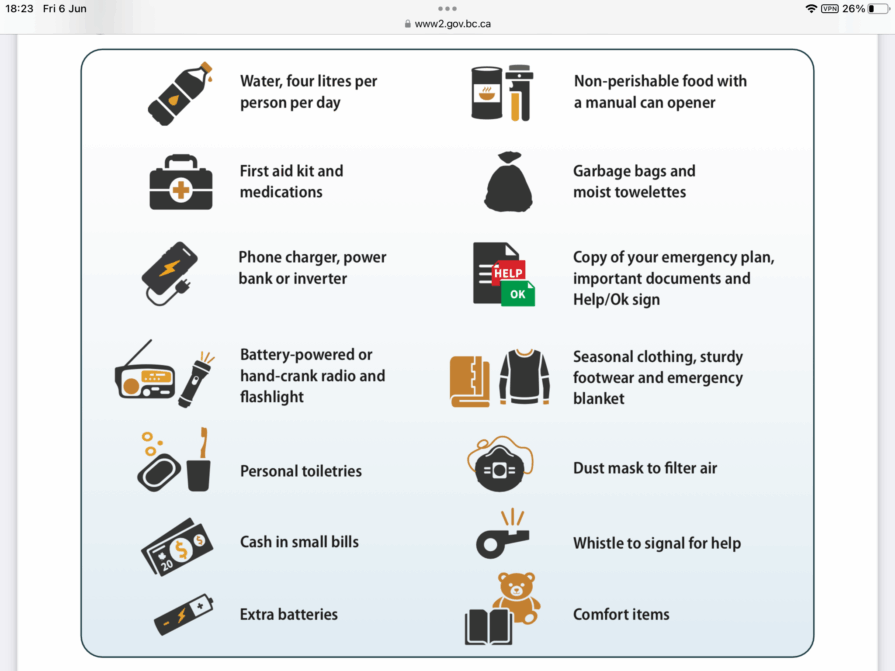
Some people might like to think of preparing a grab bag like this suggested by Canadian authorities.
If disaster strikes,
- Don’t Panic.
2. Determine the facts.
If there is internet and telephone communication – use trusted sources. If communications are down – go to the Police or the Town Hall since these organisations have special communications pathways with the Valencia Government Emergency Coordination centre : https://avsre.gva.es/es/web/emergencias/centro-de-coordinacion-de-emergencias
3. Some tips in case we have another long power cut!
- Be resilient and help others
- Keep some cash
- Keep a backup battery (power bank) for your phone
- Keep car petrol topped up
- Remember – the car has a radio
- Know your neighbours – help to inform them and stop unfounded rumours
- Share candles and gas cookers
- Remember, a full freezer stays frozen for longer
Good luck!
Chris Betterton-Jones – Knowledge Junkie